Bitcoin’s Two Leashes
Age-dependent volatility model indicates Bitcoin’s price now at the most negative local Z-score in its history

Introduction: Is Bitcoin More Undervalued Than in 2022?
Bitcoin trades today near $61,000, while the long-term power law implies $133,227. Many observers would conclude that Bitcoin is dramatically undervalued.
However, a 50% deviation from trend meant something very different for a two-year-old Bitcoin than for today’s seventeen-year-old Bitcoin.
To compare different eras fairly, we need a volatility model that evolves.
The Dog, the Owner, and the Leash
Imagine a dog walking beside its owner. The dog wanders left and right, sometimes far away, but remains attached by a leash.
Bitcoin’s price behaves similarly. The power law is the owner’s path. The residual is the distance between the dog and the owner.
One key question is: how long is the leash? A second one is: does the length vary with Bitcoin’s age? And a third question is: are there two leashes, one for uphill excursions and one for downhill, possibly of differing length?
Measuring Distance from the Power Law
Define:
r = log P - log Ptrend
Where r is the log base 10 price residual, P is current price and Ptrend is the power law trend price.
Then we have the residuals vs. calendar year shown in Figure 1. There are very strong bubbles that have declined in amplitude with time and clear bear markets or trough regions that also seem to be somewhat less deep with time. We also see persistence in the residuals on the time scale of weeks and months; it takes a while for bubbles and troughs to play out, of order a year is typical.
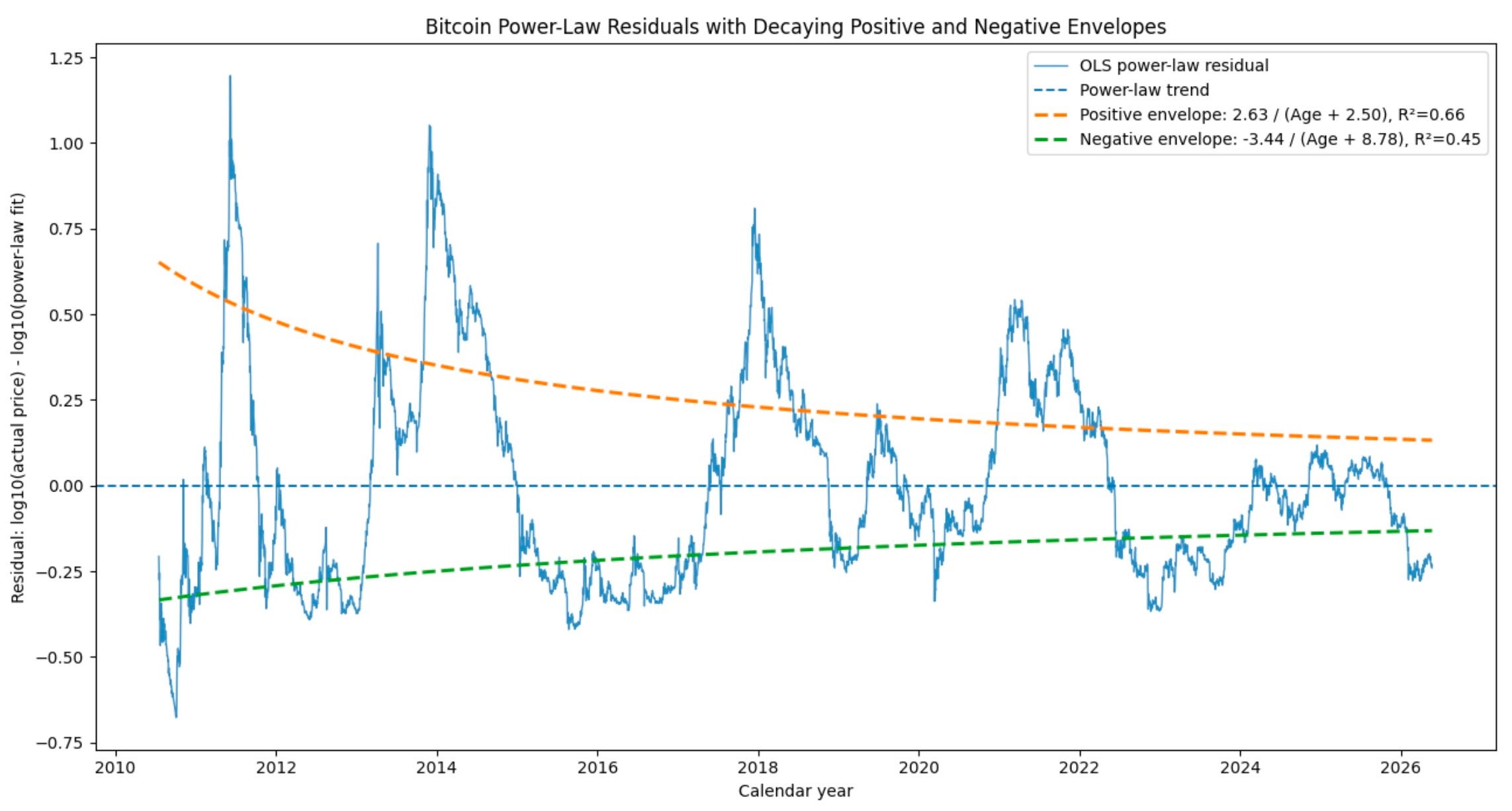
Bitcoin’s Two Leashes
The simplest approach is to fit the average residual magnitude. This reveals a declining envelope for the absolute value of the residuals approximately of the form, using annual averages:
E(|r|) = 4.0 / (Age + 8.0) and with R2 = 0.51, a rather decent fit for a noisy series.
But the market is rather clearly not symmetric, with larger upside excursions than downside. The history is suggesting that we model using two separate leashes.
That can be an uphill leash with more slack, we don’t mind so much when the dog is ahead of us, and a downhill leash that is shorter. Currently the leash lengths are comparable, but earlier on, the uphill leash was about twice as long in log price terms.
I grouped the positive residuals and negative residuals separately and determined annual averages and then fit with
E( r+) = a+ / (Age + δ+)
and find a best fit a+ = 2.63, δ+ = 2.5, thus 0.58 at age 2 and +0.13 currently.
And,
E( r-) = a- / (Age + δ-)
with a- = -3.44, δ- = 8.78, which yields -0.32 at age 2 and is -0.13 currently, the same amplitude as for the positive residuals, but with a negative sign. Both envelopes therefore contract quite substantially with age.
