Bitcoin Maturity Index: Lambert-W
Lambert-W, Autopoiesis, and Lock-in

Lambert-W
There are a number of processes in nature that exhibit self-regulating exponential or superlinear growth with feedback. Examples are found in river basins, biological growth rates and metabolic scaling, and technological networks. Systems of this nature generally transition from rapid expansion to a more constrained and therefore more stable development, governed by their own accumulated structure.
One way to express this is through the Lambert-W function. We can think of W as a maturity index for the network or system.
The defining relation is the Lambert equation for a process that initially grows exponentially but is modulated via feedback within the system (exp is the exponential function):
W exp{W} = X
The interpretation is:
Exp{W} → raw exponential amplification (early growth)
W → self-interaction / feedback loops / constraints
W exp{W} → exponential growth that is beginning to be shaped by its own scale
Here X is some controlling metric of the system, typically cumulative and representing the scaling, e.g. network depth.
Then, W measures how strongly a system is regulated by its own accumulated state (endogenous feedback) rather than by external forcing. A value of W greater than 1 marks the transition to a feedback dominated regime, while W greater than 1.25 suggests irreversibility of a self-reinforcing structure. A value of W approaching 1.5 indicates an autopoietic regime with a lock-in of key scaling relationships.
The Internet is Allopoietic
Table 1 below reports estimated Lambert-W maturity scores for a range of different networks. Systems such as gold (as money), electricity, railroads, and fiat are durable but fundamentally allopoietic: they depend on external control. These systems tend to stall at or below W ~ 1 as they develop. They never reach the W ≈ 1.5 level that indicates strong internal regulation, or autopoiesis.
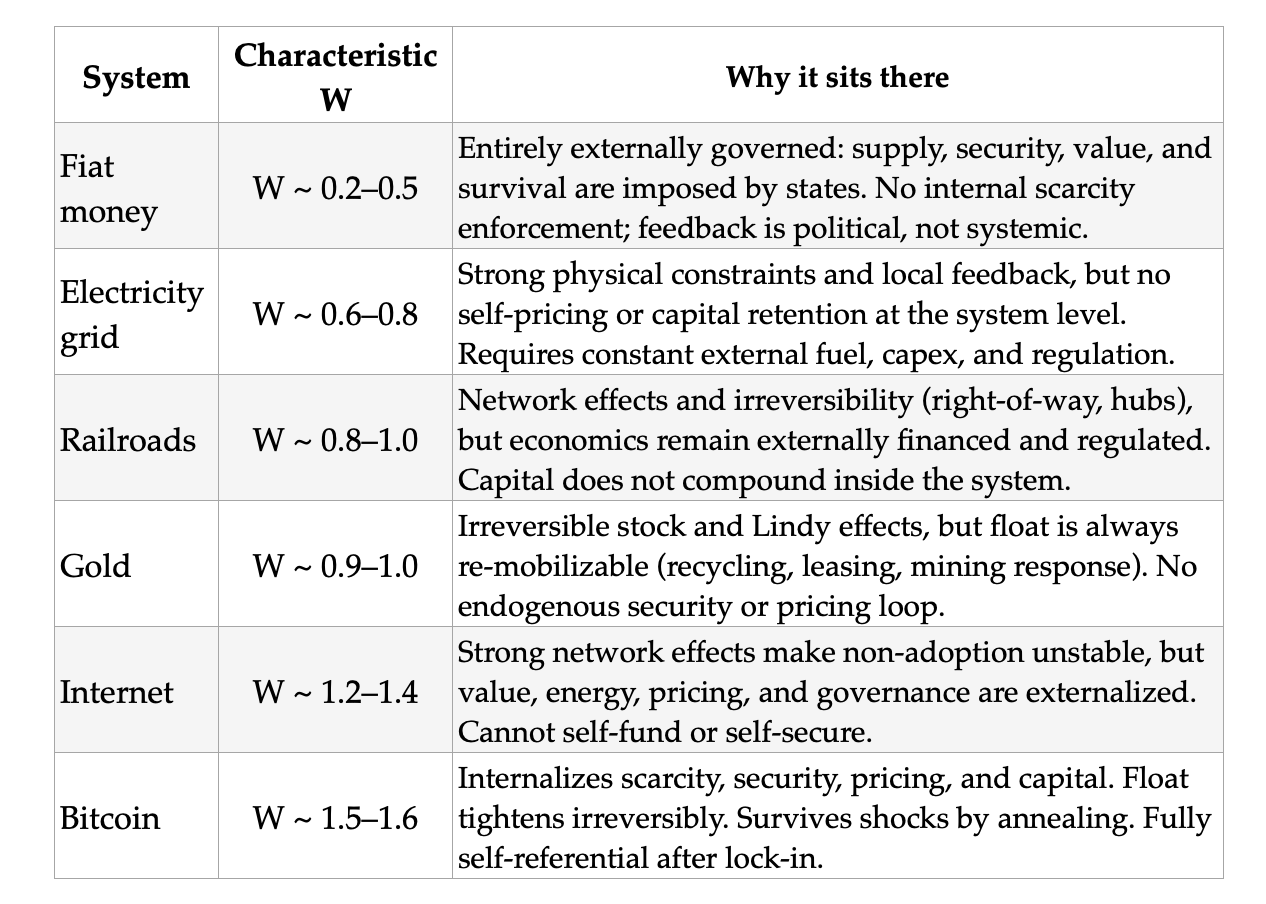
In this list Bitcoin is the only system that exceeds a W ≈ 1.5 threshold, associated with not only lock-in but also steep scaling laws. See this article:

on the autopoietic nature of Bitcoin and the allopoietic, externally controlled, nature of fiat and gold.
The Internet is instructive by contrast, especially since Bitcoin is money of, by, and for the Internet. Next to Bitcoin it has the highest W score in the table, indicative of strong persistence and network effects. But it still relies mainly on external control variables — value, pricing, energy, governance, funding, and security — being the key variables for evaluation. The Internet resembles other large-scale infrastructure systems such as railroads, in that it is not self-producing.
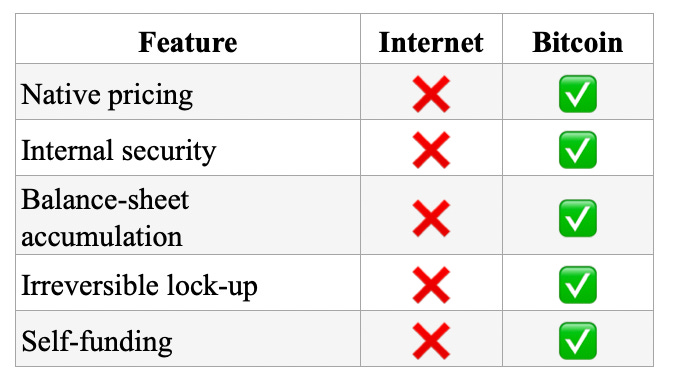
Table 2 compares the Internet and Bitcoin across key attributes for autopoiesis, including security, ledger ownerhsip, intrinsic pricing (issuance and defined units of account), and long-term holding behavior. The Internet and Bitcoin, although complementary, are qualitatively distinct: Bitcoin couples computation, security, issuance, and value into an endogenous feedback loop, whereas these functions are supplied externally for the Internet. While the Internet also grew its user count as a power law for much of its life, it was less steep than the Bitcoin address count power law.
Bitcoin is Autopoietic
Bitcoin scores about 4 or 4.5 on a 5 point scale for autopoiesis (see article referenced above). Using four key criteria, reasonable scores are:
Value: 5 - the value is created and managed endogenously; the monetary supply schedule is difficult to alter
Security: 5 - security is intrinsic to proof-of-work: hashing and a winner take-all game for a block reward and to create the time-chained, distributed ledger
Governance: 4 - governance is highly stable, protocol changes happen very deliberately and slowly
Energy: 3 - external energy is required but it is regulated by internal incentives and the consensus dynamics
This yields an average 4.25 autopoiesis score.
An excellent proxy for the controlling variable X in the Lambert-W relation is the cumulative power law index k (slope). Early in the history of Bitcoin it fluctuated substantially, but locked into a range of 5.5 to 6 around a decade ago, when measured in dollar terms. Currently the best fit ordinary least squares power law slope is 5.7 (when measured in Bitcoin vs. gold terms it is 5.3).
The natural question around maturity is: when did Bitcoin cross into the regime where its own historical accumulate scale became the dominant stabilizing force? In Lambert-W terms this is when the system reached W ≈ 1.5 — locking in the power-law exponent as a consequence of strong endogenous feedback, and making Bitcoin structurally irreversible, for all practical purposes.
The cumulative k is a summary statistic of long-run scaling; its observed stabilization is a signature of maturity.
Bitcoin’s Power Law Locks in
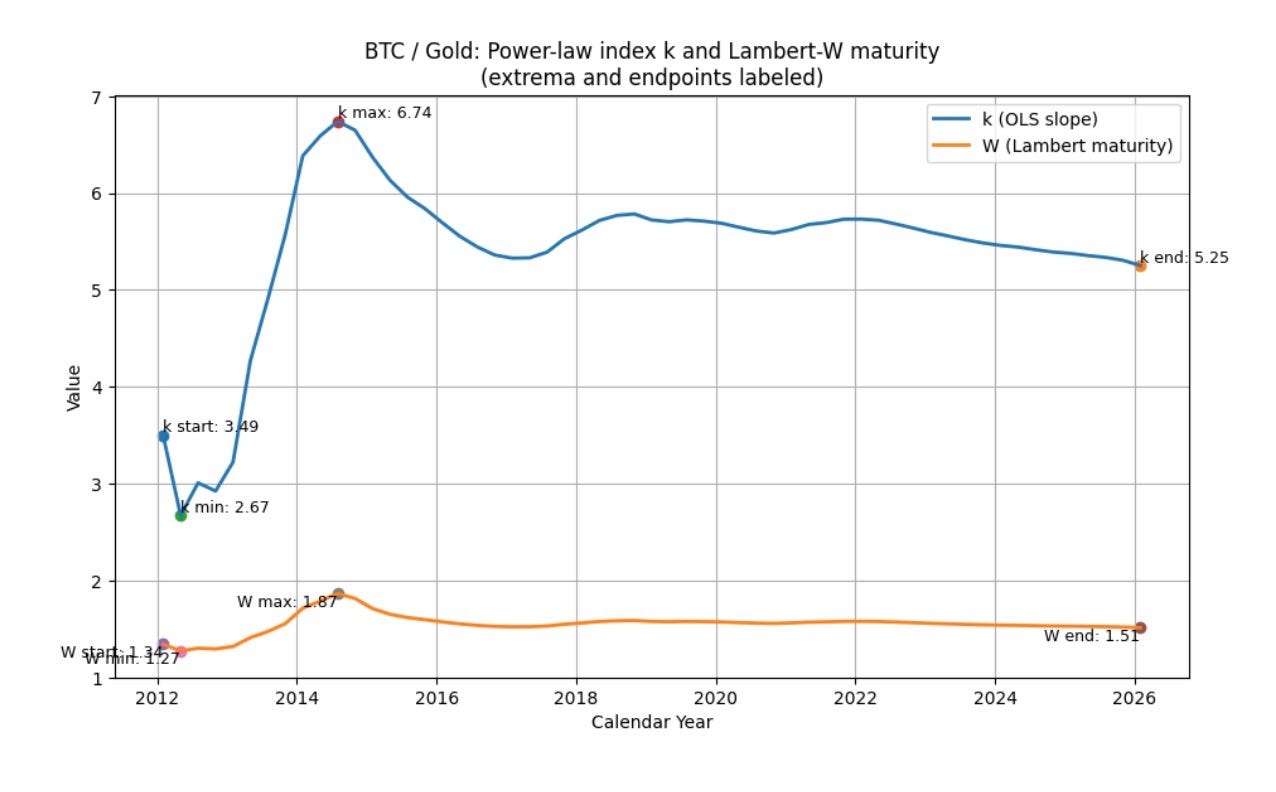
The figure below shows the power law exponent derived from Bitcoin’s price in gold, a somewhat more demanding test of the lock-in hypothesis than using US dollar prices. The blue curve is the rolling power law index k (using only available historical data). One sees that it fluctuated significantly during the first few years, but by late 2015 it became confined to the range of [5, 6], and is presently equal to k ≈ 5.25 (Bitcoin vs. gold).
During the early years of Bitcoin, the power-law exponent relating price to age was inherently unstable, reflecting its short history, thin liquidity, and rapidly evolving market structure. As the network aged and matured, however, both the volume of data and — more importantly — the dynamic range over which the scaling law could be tested, expanded rapidly.
Systems with exponential growth and feedback do not converge gradually; they pass through a natural “lock-in” point after which key parameters become increasingly resistant to change. In Bitcoin’s case, the k-versus-age plot shows this transition clearly around an age of roughly seven years (early 2016). Beyond that point, the fitted exponent remains bound in a narrow range, with subsequent fluctuations reflecting intermediate-term market dynamics rather than uncertainty about the underlying long-term scaling law.
The power-law index stabilizes once Bitcoin’s age and market depth become large enough that deviations are strongly self-correcting, producing a quite visible lock-in around age ≈ 7 years.
Bitcoin’s Lambert-W index of Maturity
The lower orange curve plots W, the Lambert maturity index, derived from the power-law exponent series until any particular time. It crossed the 1.5 threshold as early as 2013 and has remained above that level since. The lock-in that became clear after 2016 seems to have been pre-signaled around three years prior to that, by the system’s inherent dynamics.
In the early years of Bitcoin, the estimated power-law index relating price to age was highly unstable, reflecting short history, thin liquidity, and rapidly evolving market structure. As the network matured, however, both the amount of data and—more importantly—the dynamic range over which the scaling law could be tested expanded rapidly.
Lock-in here means that internal dynamics resist external shocks, the system evolves to be anti-fragile; disturbances do not alter the fundamental structure, but contribute to annealing in the power law exponent. That index becomes nearly constant, with only minor fluctuations.
When Bitcoin reached W ≈ 1.5, its own scale became the dominant stabilizing force — locking in the power-law exponent and making Bitcoin structurally irreversible.
For systems of this sort, when the maturity index W reaches 1.0 feedback starts to matter, when it reaches 1.25 reversal is unlikely, and when it reaches 1.5 irreversibility is baked in and the structure of the system is self-reinforcing.
Bitcoin’s W trajectory shows this progression. The orange curve crosses ≈ 1.25 representing feedback becoming dominant during 2013, rose as high as 1.87 as a consequence of the 2011 and 2013 bubbles, and settled back to its long term range of 1.5 to 1.6. That behavior suggests a mature, self-regulated regime.
Other systems with W of 1.5 or greater include:
Main-sequence stars, that balance fusion energy generation (with an exponential dependence on core temperature) against self-gravity of the stellar core’s mass (power law),
Morphology of very large river basins, such as the Mississippi and Amazon systems, and
Dominant technology standards such as TCP/IP, upon which the Internet has been built.

Stars on the main sequence have lifetimes of billions of years, and TCP/IP is not going to be ripped out and replaced anytime soon. I assert that Bitcoin itself is a technology standard of the same class. It is also the first scientifically precise monetary standard in history as a consequence of its exactly finite supply.
Bitcoin’s lock-in arises from multiple, reinforcing feedback loops:
Proof-of-work security
Hash-price reflexivity
Difficulty adjustment each fortnight
Halvings every four years
Capital ↔ price ↔ security coupling
Lindy reinforcement (longevity leads to more longevity)
Network anti-fragility against shocks
Lock-in does not mean no bubbles and crashes. Volatility has been declining, however. Bubbles in 2017 and 2021 have not changed the power law slope appreciably. Lock-in means that scaling stabilizes, the power law index stabilizes and price excursions are mean reverting to the long-term trend. Shocks anneal the structure rather than weaken it; there is a persistent long-term attractor.
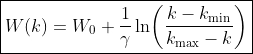
I map the cumulative power-law exponent k onto a bounded Lambert-W maturity coordinate using a logistic transform. Stabilization of k corresponds to saturation of W.
I use an inverse logistic transform (logit) to derive W from the power law index history k as a function of Bitcoin age. W is not a physical entity, it is a dimensionless parameter representing feedback strength and reflecting maturity, stability of the Bitcoin network seen in the observable k, the power law index. The logit takes this form:
Reasonable parameter choices were chosen to be:
kmax =7.0 (upper sustainable ceiling)
kmin = -1.0
W0 = 1.3 is a crossover parameter for feedback dominance
γ = 6 as the maturity ramp, fairly sharp as observed
Capital Flow and Structural Lock-In
Bitcoin exhibits exponential micro-dynamics, but it operates within macro-scale capital constraints. Short-term price movements reflect reflexivity, leverage, narratives, and adoption waves, producing bubbles with temporarily superlinear behavior. These dynamics are nevertheless constrained by finite risk capital, margin limits, market depth, regulatory channels, and the availability of fiat on-ramps.
As Bitcoin grows, these constraints become increasingly stiff. At the same time, coins tend to migrate into progressively stronger hands: from traders, to ETFs, to corporate treasuries, and ultimately to sovereign or quasi-sovereign holders. Each step reduces the elasticity of the available float and lengthens holding horizons. The result is persistent downward pressure on effective supply.
In Bitcoin’s early years, price was largely set by capital flow relative to new issuance, with miners acting as forced sellers. During the 2014–2017 transition, issuance became less dominant, secondary markets deepened, and a cohort of long-term holders emerged. Price increasingly reflected capital inflow versus an inelastic stock of coins, stabilizing the long-run power-law behavior.
Once issuance declined further and higher tiers of capital entered, Bitcoin crossed a Lambert-W maturity threshold. From that point onward, price dynamics became dominated by capital-versus-float rather than flow-versus-issuance. Bubbles and crashes persisted, but deviations increasingly reverted to the long-term power-law trend. Shocks annealed the structure rather than destabilizing it.
Early Bitcoin behaved like a commodity startup, with price driven by flow. Mature Bitcoin behaves like a monetary network, with price determined by capital stock relative to available float.
The Sun endures because fusion holds gravity in check. Bitcoin endures because proof-of-work, rooted in energy and hash power, counteracts external shocks. In both systems, power-law scaling marks a stable, long-lived equilibrium.
Next Physics of Bitcoin with Gio Wednesday 7 PM Pacific
Stephen, I don’t know how you do it, other than through your intellect and your intuition gained through decades of experience in astrophysics, life sciences and now, monetary matters.
Each post is better than the last. Together these posts will offer a technical baseline of truths on which a growing set of monetary specialists and investors cannot refute their mathematical bases.
How is work at the new Institute progressing? I’ve seen no recent collaborative posts from you and Gio. I sincerely hope that this is because the work at the Institute requires so much of the attention of all those working at the institute.
Personally, my conviction in the resiliency of Bitcoin over long durations is founded on the work you and others have done with power law. The conviction of Pundits on YouTube seems founded upon non-scientific history of number go up. IMHO, that’s a poor foundation of conviction.
Lock-in assures me that external perturbations will not yield corruption of power law, other than moon-sized planetoid ending human life on Earth - or the Rapture!